
Why clusters matter for Europe’s future: Key messages from the first ECA Cluster Conference
Madrid, Spain | 10–11 December 2025
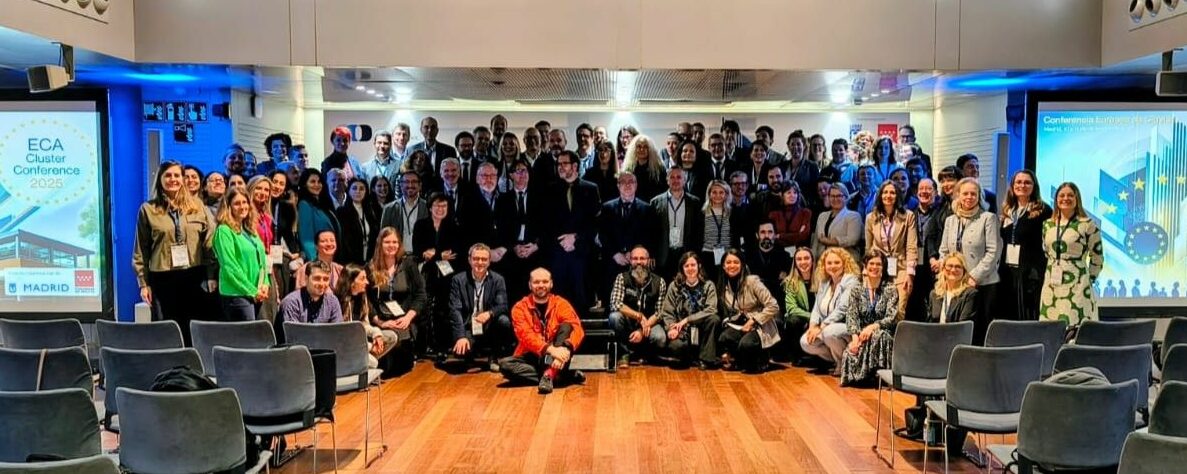
The European Clusters Alliance (ECA) successfully hosted its first Cluster Conference on 10–11 December 2025 at the Pabellón Cecilio Rodríguez in Madrid’s Retiro Park. Bringing together more than 150 participants from across Europe, the event marked a major milestone for the European cluster community and confirmed the growing recognition of clusters as strategic actors for European competitiveness. The conference was organised in collaboration with the Madrid City Hall (Ayuntamiento de Madrid) and the Madrid Community (Comunidad de Madrid).
High-level policymakers from the European Commission, city authorities and the Spanish Ministry of Industry and Tourism, alongside representatives of national and regional agencies, cluster organisations and associations, and EU-funded project consortia, gathered to discuss how to strengthen cluster services and policy frameworks in line with new European priorities. Discussions focused in particular on the upcoming Multiannual Financial Framework (MFF) and the European Competitiveness Fund, with clusters repeatedly highlighted as practical instruments for delivering policy objectives related to industrial transition, value chain strengthening and innovation diffusion.
On 9 December, the conference started with a pre-work in the so-called “Co-Creation Labs”, designed to foster hands-on discussions among cluster leaders, practitioners, and experts. Under the guidance of Antonio Novo Guerrero, President of ECA, participants explored how clusters can best support Europe’s competitiveness under topics such as SME collaboration, digital and green cluster services, and skills and internationalization. The outcomes of these group discussions were presented at the main conference, ensuring that practitioner insights shaped the policy debate.
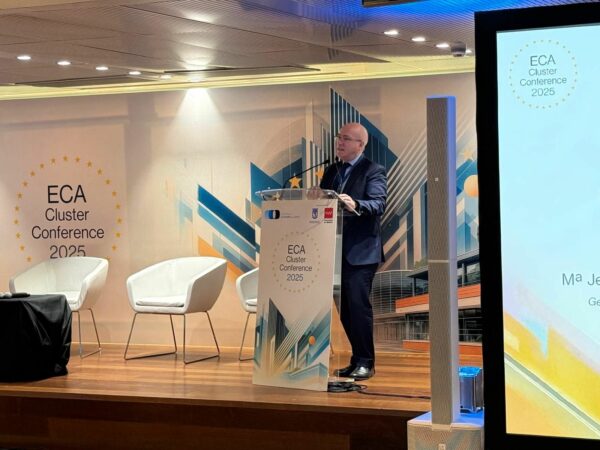
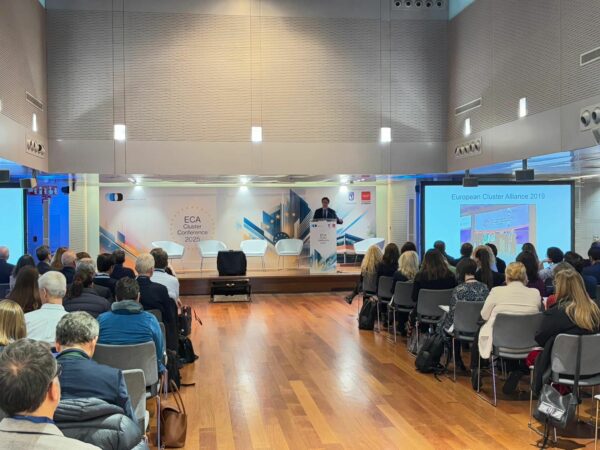
Opening the Conference on Day 1, María Jesús Romero de Ávila Torrijos, General Director of Economy at Madrid City Council, highlighted clusters as powerful instruments for collaboration and knowledge exchange, particularly at local and regional level. Antonio Novo Guerrero, President of the European Clusters Alliance, underlined the importance of close cooperation between ECA, the European Commission and Member States, stressing that clusters play a crucial role in strengthening Europe’s competitiveness in an increasingly complex economic and geopolitical context. Luis Socías Uribe, CEO of Invest in Madrid, reaffirmed Madrid’s commitment to innovation, investment and collaboration between clusters, companies and universities.
From an EU policy perspective, Marek Przeor, Team Leader for Clusters at DG GROW, European Commission, emphasised the importance of resilience, value chains and collaboration. He highlighted ECA’s contribution to EU-level initiatives such as the European Cluster Collaboration Platform (ECCP) and its services Clusters Meet Regions, EU Clusters Talks and the Cluster Booster Academy. These exchanges reinforced the view that clusters are uniquely positioned to translate European policy priorities into concrete action within industrial ecosystems.
A central theme throughout the Conference was the future EU for Business Network. While the European Commission proposal foresees building on existing structures such as the Enterprise Europe Network (EEN), the ECCP and other networks, clusters clearly expressed their ambition to play a core role in its design and implementation. Discussions highlighted the importance of positioning clusters as equal and complementary partners to EEN, with a model based on joint referral mechanisms, shared pipelines and coordinated outreach. Preserving the specificity of the cluster approach was seen as essential, particularly its distinctive strength in ecosystem-building through trusted long-term networks, specialised services and strong delivery capacity anchored in industrial and regional ecosystems.
Closing Day 1, Jordi Garcia Brustenga, Secretary of State for Industry, Spanish Ministry of Industry and Tourism, highlighted that cluster policy remains one of Europe’s most successful tools for strengthening competitiveness and innovation. Jordi also recognised the vital role of ECA, noting that its voice is strong, strategic, and essential for the future of EU clusters.
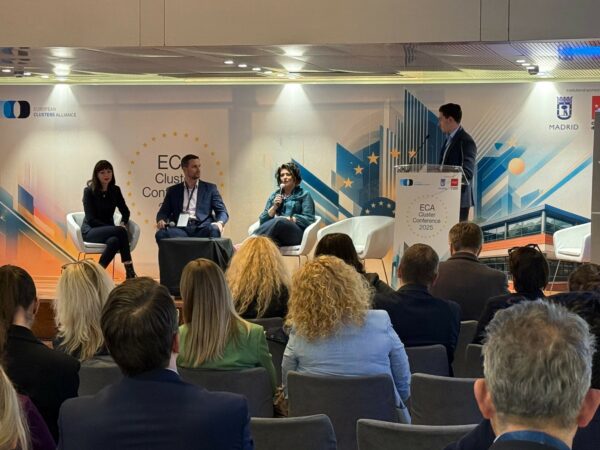
Day 2 of the Conference reinforced a clear message: Europe’s industrial transition and competitiveness will depend on stronger, better-funded and strategically recognised clusters, acting as partners in policy design and implementation rather than temporary project beneficiaries. The roundtables centred around cluster activities for the implementation of the Industrial Transition Pathways, the future of cluster services and support mechanisms as well as policy instruments where clusters can play a role. Additionally, Marek Przeor presented STEP, the Strategic Technologies for Europe Platform, which aims to redirect funding under existing programmes for critical technologies. In turn, the Polish Cluster Association addressed the 10-year limit on operational aid for clusters under the GBER in an input presentation, arguing that this limit does not reflect the reality of cluster development, which requires long-term stability to generate impact.
In his closing remarks, Jaime Martínez Muñoz, General Director for Economy and Industry of the Madrid Regional Government, referenced the industrial plan of the Comunidad de Madrid and confirmed that clusters will play an active role in its implementation. Then, interested participants went to site visits to the local clusters CITET and the Clúster Audiovisual de Madrid, reinforcing the link between policy discussions and real-world innovation ecosystems.
By combining strategic policy debate with hands-on co-creation and strong stakeholder engagement, the first ECA Cluster Conference confirmed the central role of clusters as trusted partners in Europe’s industrial and innovation ecosystem, and laid the groundwork for future policy developments at both EU and national level.